






What does the future hold for alternatives to NMC lithium-ion batteries in France?
The 7th meeting of the Batteries Working Group, organised by Tenerrdis on 10 February, provided an opportunity to review alternative chemistries to NMC Li-ion batteries, addressing the technical barriers, safety and cost issues associated with these technologies.
- All thematics
Speakers:
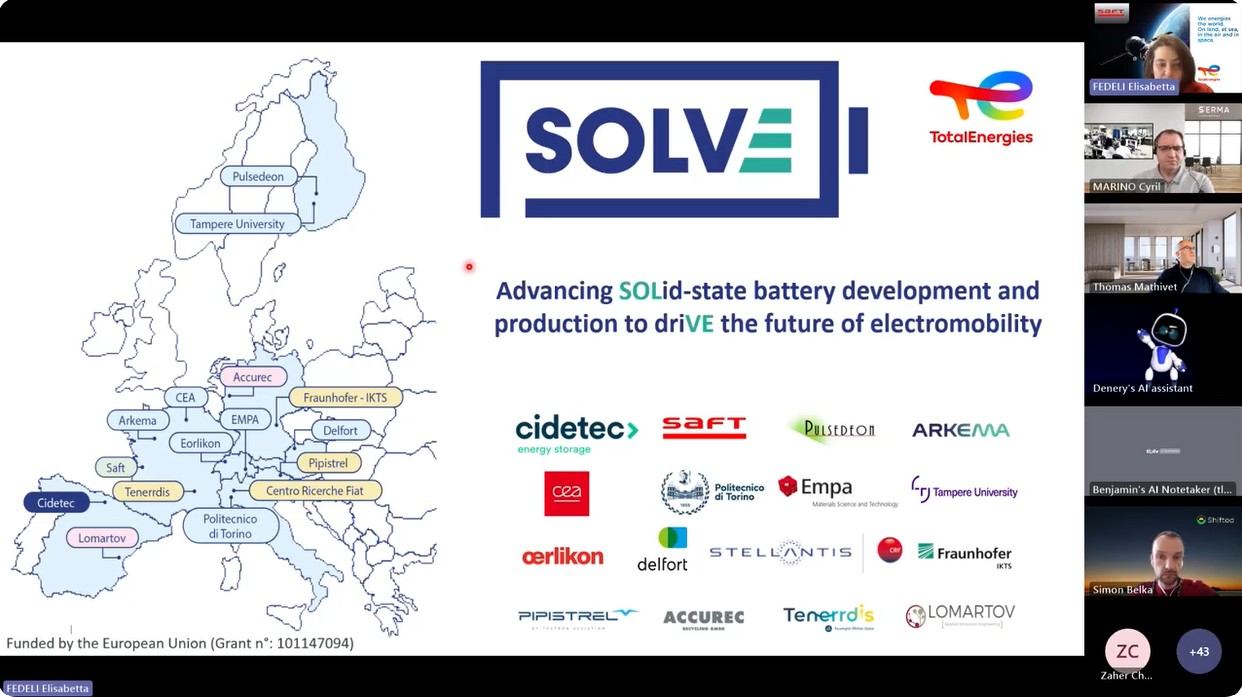
- Elisabetta FEDELI, Saft, (for SOLVE project)
- Cyril Marino, Serma Technologies
- Laurent Garnier, CEA i-tésé
- Jean-Luc Cialdini, EasylZinc
Context & challenges for the sector
The webinar was organised against a backdrop of profound technological and industrial change. NMC lithium-ion chemistry, long considered the benchmark for electric mobility applications due to its high energy density, now faces competition from other battery chemistries. Rising costs of critical materials, geopolitical dependencies and the rise of LFP, particularly in China, are reshaping the balance within the sector. This realignment is prompting European players to explore other avenues, such as sodium-ion technologies, all-solid-state batteries, zinc-based systems, and other chemistries. The challenge is twofold: to ensure industrial sovereignty whilst reducing risks related to supply chains and the security of storage systems.
Technology focus: maturity, barriers and trajectories
An analysis of the various technologies presented during the webinar highlights the significant differences in maturity and industrial trajectory between the main alternative chemistries. NMC batteries retain an advantage in terms of energy density, particularly for long-distance mobility, but their reliance on strategic materials and the risk of high economic volatility limits their future competitiveness. Conversely, LFP, now mass-produced in China, holds a dominant position in stationary storage and is gradually gaining ground in mobility.
Sodium-ion is emerging as a promising solution for stationary applications or vehicles with limited range. Its low-temperature performance and independence from lithium make it a robust candidate for markets where cost takes precedence over absolute energy density. The main challenges relate to the optimisation of cathode materials, thermal stability and industrial scale-up.
Solid-state batteries, on the other hand, represent a more profound paradigm shift. Their potential lies in the combination of increased energy density and superior intrinsic safety, but the barriers to industrialisation remain significant: the mechanical stability of solid electrolytes, interface management, and forming processes that are still costly. Their adoption is expected to follow a gradual trajectory, starting with premium applications.
Finally, zinc-based batteries offer a viable alternative in environments where safety is a top priority. Their low cost, thermal stability and ease of production could encourage their adoption in specialised segments and certain industrial applications.
A technical and economic analysis of stationary energy storage
The stationary energy storage market is experiencing unprecedented growth, driven by the rise of renewable energy and the growing need to stabilise electricity grids. Battery costs have fallen dramatically since 2022, with an average drop of nearly 30% for LFP systems. This trend is driven by the mass production in Asia, the optimisation of industrial processes and improvements in component performance.
The cost structure of utility-scale systems is primarily based on racks, thermal management systems and energy conversion equipment. Added to this is the grid connection, the cost of which varies significantly depending on the local availability of infrastructure. Analyses show that a turnkey system currently costs around €200/kWh in Europe, compared with nearly $100/kWh in China. This disparity is mainly due to the industrial maturity and mass production capacity of Asian manufacturers.
The LCOS (Levelised Cost of Storage) is a key indicator for assessing the economic viability of projects. It is heavily influenced by the number of cycles achievable, battery ageing and the system’s overall energy efficiency. Business models combining arbitrage, grid services and capacity provision are becoming increasingly important for maximising profitability, provided that the risks of cannibalisation between services are managed effectively.
Key takeaways from the Q&A session
Discussions with participants helped to clarify several key technical points regarding all-solid-state batteries. It was noted that the final weight of a module depends heavily on safety devices and the mechanical housing, regardless of the theoretical mass of the cells. Scaling up thin-film deposition processes for lithium-metal anodes, particularly via PLD (Pulsed Laser Deposition) technology, remains a significant industrial challenge, with the timeline for industrialisation still uncertain.
The question of whether solid-state batteries are suitable for stationary storage has also been raised. Whilst their enhanced safety is an undeniable advantage,
manufacturing costs and the complexity of the processes involved limit their economic viability in the short term for large-scale applications. Finally, the recycling of sodium-ion batteries already appears feasible for conventional lamellar cathodes, although other compositions will require procedural adaptations.
Strategic implications and recommendations
The diversification of battery technologies represents a major opportunity to strengthen European energy sovereignty. For sodium-ion batteries, the priority lies in consolidating local value chains, including the production of active materials, process optimisation and safety certification. A coordinated strategy at European level could accelerate the ramp-up of this technology.
For solid-state batteries, the need to establish a dedicated supply chain for equipment has emerged as a critical challenge. The development of dry processes, in-line metrology and the optimisation of interfaces are key areas for achieving levels of industrial maturity compatible with widespread adoption.
As for zinc batteries, their potential in critical applications justifies the roll-out of industrial pilot projects and collaboration with stakeholders in the defence and cybersecurity sectors. Their ease of recycling and the availability of zinc reinforce their strategic appeal. Finally, for stationary storage, revenue diversification and the securing of business models through long-term contracts remain essential to support investment.